
REVO
vs Veeva
vs Salesforce
vs IQvia
2026 Life Sciences CRM Guide
In This Guide
- 1 Veeva Vault Platform: The Enterprise Compliance Fortress →
- 2 Salesforce Life Sciences Cloud: The AI-First Generalist →
- 3 IQVIA OCE: The Data-Driven Commercial Orchestrator →
- 4 Revosuite Powered by Rx-Booster: The Prescription Growth Specialist →
- 5 Full Side-by-Side Comparison Table →
- 6 Beyond the Big Four: Other Critical Considerations →
From "Data Logging" to "Rx Growth"
The 2026 Life Sciences CRM Shift
For the last decade, the narrative was simple: Veeva or IQVia. But this "two-player dominance" was never the full story. Veeva's footprint was concentrated in Reference: Intuition LabsTop 20 pharma and mature markets—their presence in emerging regions remained minimal. Meanwhile, IQVIA's CRM journey has been turbulent: building proprietary systems, Reference: IQVIA (Press Release)acquiring Cegedim, Reference: Intuition Labs (CRM Comparison)launching OCE on Salesforce (like Veeva once did), then watching its strategic clarity evaporate as partnerships shifted.
Now, as Reference: Intuition Labs (Veeva-Salesforce Split)Veeva splits from Salesforce infrastructure and Reference: IQVIA (Press Release)IQVIA licenses OCE back to Salesforce, the landscape has fractured. Organizations face a "Migration Tax"—forced platform transitions costing millions in implementation fees, months of downtime, and zero guaranteed prescription growth. It's time to rethink your CRM strategy with clear eyes.
1. Veeva Vault Platform: The Enterprise Compliance Fortress
Veeva Vault CRM is a life sciences-specific customer relationship management platform built on Veeva's proprietary Vault architecture.
Announced in late 2022 and launched for new customers in April 2024 Reference: Intuition Labs, it represents Veeva's strategic departure from Salesforce infrastructure.
Existing Veeva CRM customers are migrating to the new Vault platform between 2025-2030, with legacy Salesforce-based Veeva CRM support ending in September 2030.Reference: Intuition Labs

What Makes Veeva Vault Stand Out:
Unified Content & Data Platform: Vault CRM sits on the same infrastructure as Vault PromoMats, RIM, QualityDocs, and other Veeva applications, enabling seamless regulatory and content management workflows
Enterprise-Grade Compliance: Built-in support for region-specific regulatory requirements across Brazil, Japan, Germany, and other markets with complex pharmaceutical regulations
Global Deployment Power: Designed for multi-country rollouts with robust validation frameworks and change control processes
Veeva Ecosystem Lock-in: Proprietary platform creates tight integration with other Veeva products but limits flexibility with third-party tools
Ideal For:
Global Top 20 pharmaceutical companies with 1,000+ sales representatives, extensive IT resources, and complex multi-country deployment needs. Organizations already invested in the Veeva ecosystem (PromoMats, Medical, RIM) gain maximum value from the unified platform approach.
Key Consideration:
Reference: Intuition LabsVeeva Vault requires significant upfront investment—both financial and organizational. Implementation timelines typically span multiple years for global rollouts, and the proprietary platform means limited migration flexibility. Organizations focused purely on commercial sales execution may find Vault's enterprise scope excessive for their needs.
2. Salesforce Life Sciences Cloud: The AI-First Generalist
Salesforce Life Sciences Cloud is a comprehensive platform purpose-built for pharmaceutical and medical technology organizations, Reference: Salesforce (Press Release)launched in June 2024.
The Customer Engagement module—Salesforce's direct answer to traditional pharma CRM—became generally available in October 2025.
Built natively on the Salesforce platform, it leverages Einstein AI and the newly launched Agentforce digital labor capabilities to automate customer engagement workflows.

What Makes Salesforce Life Sciences Cloud Stand Out:
Agentic AI Innovation: Agentforce-powered features including Pre-call Agent, Voice Agent, and Media Agent aim to reduce administrative burden and enhance HCP engagement
Cross-Organizational Integration: Seamlessly connects commercial operations with clinical trials, medical affairs, and other business functions on a unified Salesforce instance
Ecosystem & Extensibility: Access to thousands of AppExchange partners and developers means virtually unlimited customization potential
General-Purpose Foundation: While enhanced with life sciences features, the underlying platform is Salesforce's general CRM—not purpose-built from the ground up for pharma
Ideal For:
Enterprise and upper mid-market companies (500+ reps) seeking cutting-edge AI capabilities and organizations already using Salesforce for other business functions. Best suited for companies comfortable with a platform approach that requires internal development resources or partner ecosystem engagement.
Key Consideration:
As a 2024/2025 entrant, Salesforce Life Sciences Cloud lacks the proven implementation patterns of mature competitors. The "jack of all trades" nature means achieving sophisticated pharma-specific workflows often requires significant customization. Organizations should expect to invest in Salesforce expertise—either internally or through partners—to unlock the platform's full potential.
3. IQVIA OCE: The Data-Driven Commercial Orchestrator
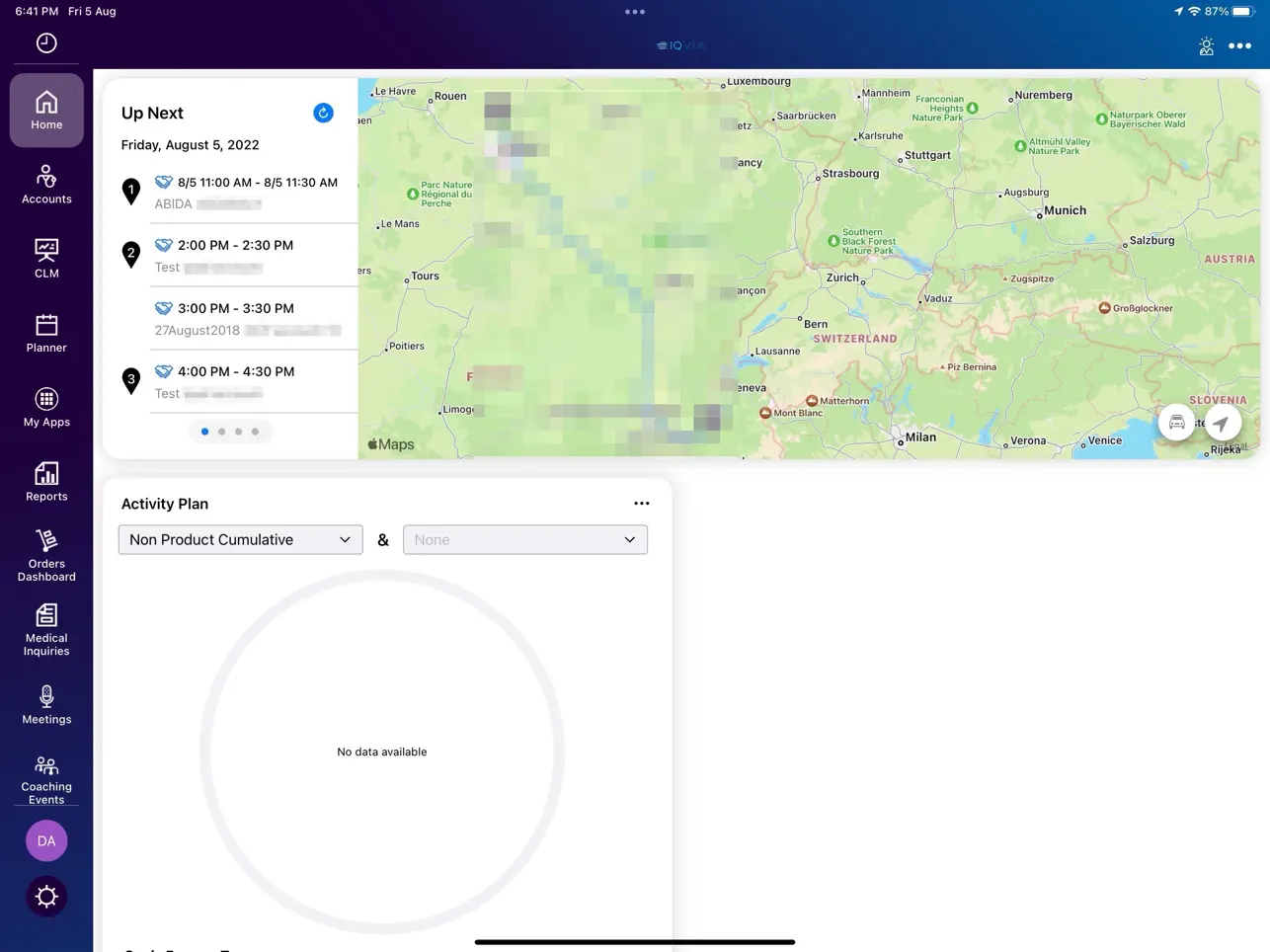
IQVIA's Orchestrated Customer Engagement (OCE) platform launched in Reference: Intuition Labs (CRM Comparison)December 2017 as a strategic offering built on Salesforce infrastructure.
OCE differentiates itself through deep integration with IQVIA's proprietary healthcare data assets, prescription analytics, and consulting services.
The platform aims to connect sales, marketing, and medical functions in an "orchestrated" commercial model that optimizes resource allocation and customer targeting.
What Makes IQVIA OCE Stand Out:
Unmatched Data Integration: Native connectivity to IQVIA prescription data, provider insights, and market analytics provides unparalleled targeting and measurement capabilities
Proven Pharma Heritage: Built specifically for life sciences commercial operations with Reference: Intuition Labs (CRM Comparison)eight years of production deployment across 115+ countries
Consulting & Services Wrapper: IQVIA's consulting arm provides implementation support, change management, and ongoing optimization—valuable for organizations lacking internal expertise
Salesforce Foundation: Built on the Salesforce platform, creating familiar technical architecture for Salesforce-experienced teams
Ideal For:
Mid-to-large pharmaceutical companies (200+ reps) that leverage IQVIA data for targeting and measurement. Organizations seeking a tightly integrated data-plus-technology solution and those comfortable with IQVIA as both vendor and strategic partner.
Key Consideration:
OCE's greatest strength—IQVIA data integration—can also become a limitation. Organizations without existing IQVIA data relationships may find less differentiated value. The current partnership with Reference: Intuition Labs (CRM Comparison)Salesforce creates some strategic uncertainty as Salesforce builds competing life sciences capabilities. Additionally, OCE implementations are typically bundled with multi-year commitments and IQVIA consulting services, limiting flexibility for companies seeking lightweight CRM solutions.
4. Revosuite Powered by Rx-Booster: The Prescription Growth Specialist
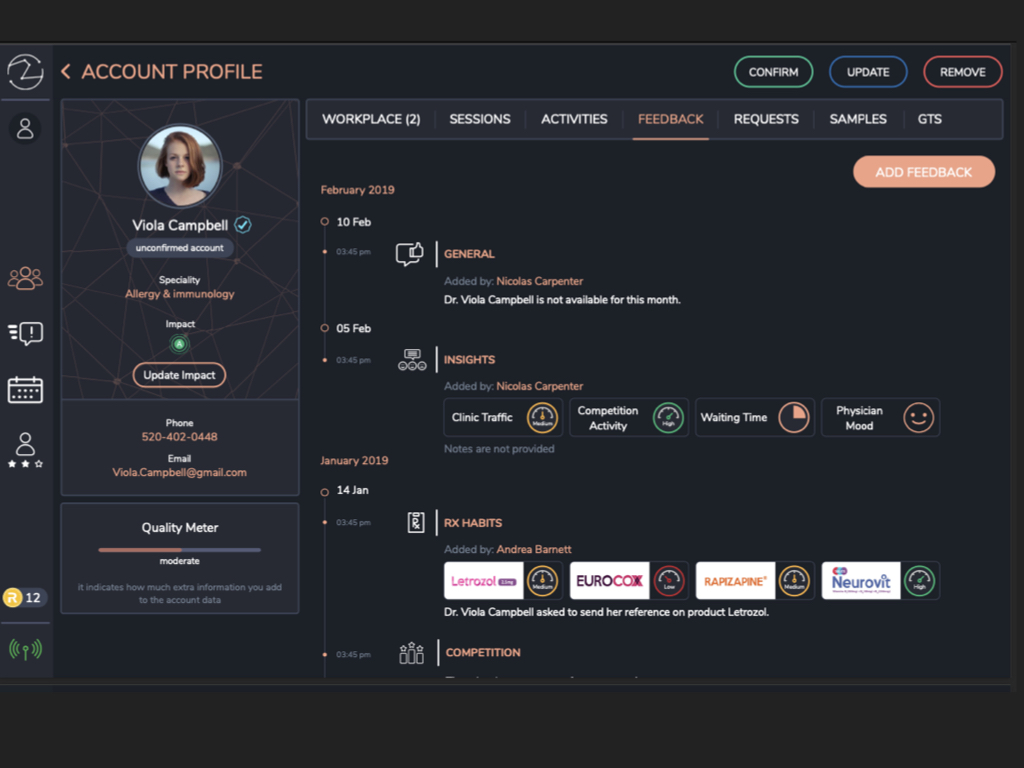
Revosuite is a specialized pharmaceutical commercial platform founded in 2011, centered on the core principle that CRM should drive prescription growth—not just log sales activities.
The platform's flagship Rx-Booster module transforms traditional detailing by converting static promotional materials into interactive, KPI-tracked digital experiences that directly connect field activities to prescription outcomes.
Unlike enterprise suites, Revosuite focuses exclusively on pharma and nutraceutical commercial operations.
What Makes Revosuite Stand Out:
Prescription-First Philosophy: Every feature is designed to track and optimize the path from HCP engagement to prescription lift, not just call completion metrics
Zero-Cost CLM Production: Rx-Booster converts existing PDF brochures into compliant, interactive detail aids without expensive agency production costs—customers routinely publish 100+ assets in their first month
Rapid Deployment: Fully operational in 1-3 months with historically proven field compliance exceeding 70%, enabling immediate ROI
Modular & Transparent Pricing: Public pricing starting at $50/user for Rx-Booster, with full enterprise deployments ranging $200-250/user—no hidden costs or forced bundles
Flexibleility: Can be used on top of other CRMs or utilize its dynamic pharma native CRM
Ideal For:
Growing pharmaceutical teams (50-400+ reps) aggressively scaling their field force while maintaining execution quality. Companies launching new products, running multi-product campaigns, or seeking to improve prescription-driven revenue without enterprise-scale complexity. Organizations frustrated with CRM platforms that excel at compliance reporting but fail to move the prescription needle.
Key Consideration:
Revosuite is a specialist tool, not a mega-suite. It excels at commercial sales enablement but doesn't provide R&D modules, clinical trial management, or quality management systems. Organizations needing enterprise-wide integration across regulatory, medical, and commercial functions should evaluate whether Revosuite's focused approach aligns with their requirements—or consider it as a complementary overlay to existing systems.
Comparative Analysis
Side by side comparison across different points and benefits.
| Feature | Veeva Vault Platform |
Salesforce Health cloud |
IQVia OCE |
Revosuite Powered By Rx-Booster |
|---|---|---|---|---|
| Best For | ||||
| Ideal Customer | Global "Top 20" Pharma; With massive internal IT teams and multi-country deployments, and deep regulatory/R&D integration needs. | Enterprises wanting "Agentic AI" & cross-org scale. | Data-heavy teams relying on IQVIA datasets. | Growing teams. aiming to scale prescription-driven revenue while staying aligned with ethical marketing standards and running frequent, multi-product campaigns at speed. |
| Company Size | Global Enterprise (1,000+ reps) | Enterprise & Upper Mid-Market (500+ reps) | Mid-to-Large Pharma (200+ reps) | Companies aggressively scaling their field force. Automated workflows standardize onboarding, visual promotion, and marketing feedback, ensuring execution quality improves—not degrades—as teams grow from 20 to 200 reps. |
| Maturity & Industry Focus | ||||
| Market Maturity | Vault CRM was announced in Reference: Intuition Labslate 2022 and became generally available in April 2024. Considered mature due to Veeva's large existing CRM user base transitioning from the Salesforce-based platform. | New entrant (Reference: Salesforce (Press Release)GA 2024). Built on Salesforce's general-purpose platform with life sciences layers. | Mature product (Reference: Intuition Labs (CRM Comparison)Launched 2017) built on Salesforce. Future innovation is now part of Salesforce's roadmap | Established specialist (Founded 2011). Innovation is centered on AI for Rx growth and sales enablement |
| Industry Vertical | Platform for Life Sciences. | General-purpose platform with Life Sciences layers. | Built exclusively for Life Sciences on top of salesforce platform. | Deep focus. Exclusive focus on Pharmaceuticals & Nutraceuticals. |
| Innovation Focus | Compliance-focused. Supports all critical region-specific capabilities and regulatory needs – from Brazil to Japan, Germany and beyond. | Innovation heavily driven by Salesforce's Einstein AI and Agentforce. The new Agentforce features for Life Sciences (Pre-call Agent, Media Agent, Voice Agent) launched in late 2025 as part of their AI strategy | Core strength is IQVIA's data & analytics pedigree. | AI for Rx Boost. Put the team on the right track to win more Rx while nurturing the company’s ethical selling principles. |
| Speed of Implementation | ||||
| Time to First Value | Very Slow: Multi-year global rollouts | Moderate: Months to years (ecosystem dependent). | Slow: Heavy data/analytics integration cycles. | Plug & Play. Fully operational within 1–3 months, with historically proven compliance exceeding 70%. |
| Setup Complexity | Reference: Intuition LabsTraditionally longer, complex implementations due to enterprise scale and validation requirements. Migration to new Vault platform adds a layer of consideration. | Reference: Intuition LabsImplementation speed can vary widely. As a new platform, proven patterns are still emerging, but Salesforce's partner ecosystem enables rapid deployment. | Typically Reference: Intuition Labslong implementation projects, often bundled with IQVIA's consulting and data services. Current partnership with Salesforce creates uncertainty. | Short implementation cycle. Positioned as a key differentiator, with promised ROI within weeks. |
| Learning Curve | Steep, with complex customization. Effective administration requires specialized skills in a "Veeva Salesforce hybrid" language, and the enterprise-grade platform demands significant training and change management. | High, due to a custom-build approach. Success often requires substantial internal staffing and resources to build and maintain industry-specific workflows on the general-purpose platform, leading to a long, costly implementation | Moderate to High. Tied to ecosystem depth. The learning curve is influenced by the platform's deep integration with IQVIA's proprietary data and analytics services, which adds value but also complexity for users and administrators. | Designed to flatten the curve. Automated, template-driven workflows reduce training time and ensure new reps are productive quickly, making rapid team expansion viable. |
| Drawbacks & Limitations | ||||
| Key Limitation | High cost and vendor lock-in into a closed ecosystem. | New and unproven in core pharma sales automation. The "jack of all trades" nature can lead to higher customization needs to achieve specialized workflows. | Strategic uncertainty due to the transition to Salesforce. Potential data lock-in with IQVIA's ecosystem. May lack the CRM agility of a pure software player. | Not a mega-suite. More of a specialist tool for pharma commercial operations, not R&D and clinical operations. |
| Not Ideal For | Can be overly complex and costly for companies focused purely on sales execution. | Complex workflows. Can't handle sophisticated business processes. | Organizations that don't have IQVIA data integrated into their operations or lack existing relationships with IQVIA's data ecosystem. | Non-commercial purposes Less suitable for companies needing deep R&D, Clinical, or Quality Management (QMS) modules. |
| Cost | ||||
| Starting Price | High and opaque. Reference: Intuition Labs Veeva does not publish its fee structure; however, industry benchmarks suggest per-user monthly TCO typically reaches the high hundreds, depending on the module mix. |
Public premium pricing
Reference: Salesforce official pricing page
:
- Enterprise: ~$350/user/month - Unlimited: ~$525/user/month - Agentforce AI add-on: ~$750/user/month. |
Complex tiered licensing. Often bundled with data and service contracts. Specific pricing is not typically public. | Public, transparent & modular. Core modules like Rx Booster start around $50 per user, while the Approval Workflows Engine begins at $35 per user. Teams combining multiple plug-and-play modules, including CRM capabilities, typically land around the $100 per user range. Enterprise deployments, building on REVO’s infrastructure with advanced controls and customization, generally range between $200–$250 per user, depending on operational complexity. |
| Detailing Materials (CLM) | Requires content creation for its Vault PromoMats application. While a modular software suite, promotional material production typically relies on specialized, licensed third-party agencies, incurring high per-asset fees | The platform's model is less defined, but its general-purpose nature suggests promotional content creation would require either internal technical resources or third-party partners, leading to project-based costs. | Similar enterprise model; the platform facilitates content use but does not handle production. Creating compliant HTML detail aids for its ecosystem also necessitates work by expensive external agencies, adding to total cost. | Zero-cost production model REVO Rx-booster converts static brochures into KPI-tracked, interactive detail aids. Customers routinely publish 100+ intelligent product assets in their first month. |
Beyond the Big Four: Other Critical Considerations
Choosing a Life Sciences CRM isn't just about picking from the headline platforms. As you finalize your 2026 strategy, here are five additional factors that could significantly impact your decision—and your organization's long-term success.
Legacy Generic Pharma Solutions: The Hidden TCO Risk
2. The AI Arms Race: Separating Hype from Healthcare Impact
Custom Build vs. Best-of-Breed: The 2026 Reality Check
CLM/Detailing: The Non-Negotiable Core of Pharma Commercial
Geographic Redundancy & Tiered Provider Strategies
Many pharmaceutical organizations still operate on systems built during the "data logging" era—platforms designed to track compliance, not drive results. With today's advancements in AI, mobile technology, and prescription analytics, the modern rep workflow looks fundamentally different.
The Problem: Legacy data-logging systems prioritize administrative tasks over productivity. Reps spend hours entering call notes, submitting samples, and updating contact records—activities that add compliance overhead but zero value to HCP relationships or prescription growth.
The 2026 Reality: Modern platforms should reduce administrative burden through automation, not increase it. If your system requires more clicks to log a call than to prepare for one, you're optimizing for the wrong outcome.
- Does my current platform maximize rep face-time with HCPs, or maximize data entry?
- Are we measuring activity completion or prescription impact?
- What's our true TCO when we factor in rep productivity loss?
Every world class vendor now promotes “agentic AI” and “large language models.” The slides all look the same—but underneath, there are two very different approaches.
Most vendors are still in the experiment phase: generic LLM wrappers with unclear use cases, no production history, and no hard evidence of prescription lift or field-force behavior change.
You see impressive demos; you don’t see audited impact on Rx, coverage quality, or execution discipline.
REVOSUITE took a different path.
Years before “agentic AI” became a buzzword, we built our commercial engine on predictive analytics—identifying high‑potential HCPs, forecasting territory performance, and detecting prescription drift with measurable ROI, not promises. That foundation is what powers our new Cognito AI Agent Platform.
Instead of using LLMs as toys in search of a problem, Cognito agents sit on top of proven data and models:
- Cognito Pulse: doesn’t hallucinate insights; it reads real execution data (adoption, discipline, customer consistency, detailing quality) and explains what changed and why.
- Cognito Compass : doesn’t guess territories; it uses historical patterns and predictive signals to highlight turnover risk, abandoned customers, and better workforce allocation.
- Cognito Coach: helps reps work more effectively by automating field planning, suggesting territory coverage improvements, and turning detailing quality analytics into concrete coaching actions they can apply in daily visits.
- Cognito Signal: supports FLMs by highlighting specific areas for improvement, automatically drafting and structuring action plans, and even notifying reps on the manager’s behalf so coaching turns into consistent execution, not just feedback notes.
- Cognito Insight: serves marketing by analyzing detailing material usage, surfacing what content is under‑used or off‑message, suggesting what needs to change, and launching targeted HCP surveys where data is silent—then automating rep follow‑up plans to double down on what works.
Take AI Claims with Caution. Ask vendors:
- What specific problem does this solve?
- Show prescription data, not demo videos
- Which pharma companies deployed this successfully?
If a vendor can’t answer with a clear, concrete use case, that’s a red flag. If they can, it’s then up to you to evaluate whether that use case fits your reality, data, and compliance constraints
- Predictive analytics since 2019.
- Cognito agents in 2026 to operationalize it.
- One roadmap: measurable prescription growth and ethical promotion at scale—not experiments you pay to test.
Some organizations consider building proprietary systems or heavily customizing platforms—especially when they have unique regulatory needs or deep IT resources.
When Custom Makes Sense:
- Ultra-specific regional compliance requirements
- Unique business models not supported by commercial platforms
- Existing enterprise architecture requiring tight integration
The Hidden Costs:
- Maintenance Burden: Who updates your custom code when regulations change?
- Talent Dependency: Custom systems create key-person risk if developers leave
- Falling Behind: Commercial platforms ship quarterly updates; custom builds stagnate
- True TCO: Calculate 5-year costs including internal FTEs, not just licenses
Bottom Line: Most organizations overestimate the value of custom builds and underestimate long-term maintenance costs.
Closed-Loop Marketing (CLM) is where compliance, content governance, and revenue generation intersect—yet many CRM evaluations treat it as an afterthought.
Why CLM is Critical:
- Compliance Risk: Every promotional interaction must be pre-approved, tracked, and auditable
- Content Production Costs: Traditional CLM often requires expensive agencies ($3K-$10K per detail aid)
- Measurement Gap: Most systems track "calls completed" but can't prove which content drove prescriptions
Critical Evaluation Criteria:
- Can marketing teams create detail aids without developer skills?
- Does the platform support multi-level approval workflows (Medical, Legal, Regulatory)?
- Can you correlate content engagement to prescription changes?
- Do reps retain access to content offline?
Bottom Line: If your CRM treats CLM as a separate ecosystem rather than core capability, factor in the real cost and complexity.
The 2025-2026 period exposed a critical risk: vendor concentration. Organizations relying on a single platform face disruption if vendors raise prices, change terms, or experience outages.
The Emerging Best Practice: Primary + Backup Strategy
- Tier 1 (Primary): Enterprise platform for core markets (US, EU, Japan)
- Tier 2 (Regional/Backup): Flexible platform for emerging markets or as fail-safe
Why This Matters:
- Pricing Leverage: Credible alternatives prevent vendor lock-in
- Regional Compliance: Some markets (China, Brazil) have data sovereignty requirements global platforms struggle with
- Business Continuity: Secondary system maintains operations during primary vendor issues
- Pilot Testing: Test new products in smaller markets before enterprise rollout
Bottom Line: Don't put all commercial operations in one vendor's hands. A tiered approach provides flexibility, reduces risk, and often improves ROI through fit-for-purpose solutions.